

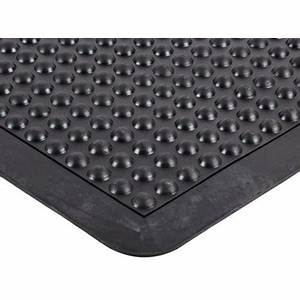
An independent garage or small workshop asks a floor to cope with wet vehicles, grit, the occasional oil drip and people standing in the same spots all day: at the ramp controls, at the bench vice, beside the wheel machine. In those spots, heavy duty garage floor mats are a practical way to protect those patches and make them more comfortable, without pretending that a few mats are a complete resin floor finish.
This guide is for independent garages, mobile mechanics with a home bay, and light workshops. It is not a specification for a public MOT lane, and it does not claim any particular mat is oil-proof or chemical-proof. Check the product details against the fluids you actually use.
Think in zones, not in "cover everything"
Walk the workshop after a wet morning. The useful zones are usually obvious:
- In front of the main bench
- Beside the tyre machine or balancer
- At a parts counter or write-up desk
- On the pedestrian route from the office to the bays
- Immediately inside a personnel door, where wet customers arrive
Vehicle tracks, ramps, two-post footprints and jacking points should generally stay as the designed floor unless a product is clearly intended and risk-assessed for that position. A mat that can be dragged by a tyre or caught by a jacking beam is a problem, not a provision.
Broader industrial rubber mats can fill standing zones that are less about vehicles and more about bench work, so you are not forcing one product into every corner.
Other heavy duty garage floor mats are worth comparing for size, because a piece that is slightly too small will skate around the one place you always stand.
Oil, water and cleaning chemicals
Most independent garages see more road wet and grit than constant floods of oil, but drips happen. Wipe them rather than leaving them to sit. If a product's guidance is cautious about oils or solvents, believe it. Compound matters; colour does not.
Degreasers used on the slab may be too aggressive for some rubber if they are left to dwell. Try the cleaner you already buy on a spare corner, or ask the supplier, before you make a whole bay of mats the test piece.
Water at the door is a different issue. A mat there should be washable and able to dry. Standing it on a permanently wet threshold simply hides the puddle. Fix obvious leaks around the door and keep drainage routes open.
Where you need a tougher standing patch that is still easy to lift and hose, compare industrial rubber mats as well as garage-specific pieces.
Benches, machines and ramps
At a bench, a mat should leave vice handles, socket rails and floor-mounted legs alone. Cut or choose a size that does not ruck when a stool rolls. If the bench has a specified load path to the slab, do not insert a soft layer under a machine foot unless the manufacturer allows it.
At tyre machines and similar kit, keep mats out of the moving parts' envelope and away from any place a wheel is rolled as a matter of course. The standing position of the operator is the target, not the whole machine footprint.
Ramps and lifts are designed surfaces. Do not add loose mats on a ramp track. If the surrounding apron is where people stand to talk to customers, treat that as a pedestrian zone and keep the mat inside it.
Comparable workshop floor mats from other ranges can help you standardise standing positions across more than one bay so staff do not invent their own offcuts.
When a larger floor finish is the better project
Mats are the wrong answer when the slab itself is breaking up, when you need a sealed, easily scrubbed surface for the whole workshop, or when customers walk through a space that has to look uniformly finished. In those cases plan a proper flooring project — which might include rubber flooring rolls in office or waiting areas — rather than hiding a failing bay under a quilt of mats.
A hybrid is common and honest: coated or plain concrete in the vehicle paths, heavy mats at the human stations, and a cleaner finish in the reception.
Housekeeping
Sweep grit; it grinds into rubber and into the slab. Lift mats to clean underneath, especially after a leaky sump job. Check edges every week. A corner that has started to lift will find a trolley wheel.
Store a spare for the busiest bench so a damaged mat can come out without leaving someone standing in a greasy hollow until the next delivery run.
Do not use workshop mats as a picnic layer in the kitchen or rest area until they have been thoroughly cleaned, if at all.
Customer-facing areas need a slightly different standard from the back of a bay. A mat at the write-up desk should look clean enough that a customer can stand on it in indoor shoes. That usually means it is washed more often than the piece at the vice, and that it is never used as a temporary drainings board for wet parts.
If more than one technician shares a bay, agree who owns the housekeeping of each mat. Shared spaces are where edges get ignored. A weekly walk-round by the person who opens up, with a note of any piece that needs replacing, is enough in a small independent garage.
Common mistakes
- Covering jacking points "to keep the floor nice"
- Choosing the thickest mat without checking door or stool clearance
- Assuming every black mat ignores oil
- Never lifting mats after a wet week
- Using small offcuts that skate in different directions
Heavy duty garage floor mats work in independent workshops when they are treated as workstation equipment: placed where people stand, kept out of vehicle paths, cleaned with compatible products and replaced when the edge or the texture has gone. That is a cheaper, more flexible upgrade than a full floor — and it should not be asked to pretend it is one.