

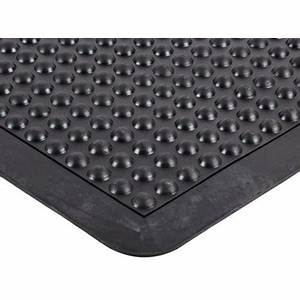
Factory Floor Mats for Production Lines and Packing Stations
A production line or packing bench keeps people standing, turning and reaching on the same few square metres for hours. Hard concrete is durable, but it is tiring and unforgiving when cardboard dust, strapping offcuts or a little moisture collect underfoot. Well-chosen factory floor mats can make those stations more comfortable and give a defined, replaceable standing zone without resurfacing the whole hall.
This guide is for operations managers, supervisors and fit-out buyers specifying mats around existing workflows. It is not a slip-risk assessment or a machinery installation manual. Suitability depends on the product specification and on how the area is used, cleaned and inspected.
Start from the task, not from a catalogue photo
Walk the line at a busy time. Note where people stand still, where they step sideways, where pallet trucks cut the corner, and where the floor is already polished smooth. Mats belong on the standing patches, not in the truck routes, unless you have chosen a product and fixing method intended for that traffic.
Typical stations that benefit include:
- Packing benches and consignment tables
- Inspection and labelling points
- Light assembly positions where operators face a jig
- Print-and-apply or scan points
- Shorted standing spots beside a conveyor, if they do not interfere with guards
Do not place a mat where it will be shoved by a stillage, caught by a pallet jack or folded into a pedestrian aisle that your risk assessment treats as a clear route.
If a longer, continuous standing strip is more realistic than a patchwork of mats, compare rubber flooring rolls for covering a defined band along the benches. Rolls reduce the number of edges a trolley wheel can catch.
Comfort, grip and cleaning as one decision
Comfort comes from a slight, stable give. A mat that is too soft feels unstable when someone turns with a box; one that is too hard might as well be the slab. The right compromise depends on footwear and how long people stand, not on choosing the thickest option by default.
Grip is about the dirt you actually have. Cardboard dust behaves differently from oil or rinse water. A texture that looks aggressive in a photo can be miserable to sweep if it traps paper fines. Ask how the night shift will clean it, and with what.
Cleaning chemicals should match both the dirt and the mat compound. A degreaser that is fine on the slab may not be suitable for every rubber. Check the product guidance rather than assuming all black mats behave the same.
When you are comparing factory floor mats from more than one range, look at edge profile as carefully as thickness. A visible, flat edge beside a packing bench is safer than a thick hidden lip on the walk side of the station.
Fitting around the workflow
Loose-laid mats are easier to lift for cleaning and to move when a line is rebalanced. They must stay put. On smooth sealed concrete that may mean a heavier mat, a suitable backing, or a fixing method approved for the floor finish.
If you bond or tape anything, consider what happens when the layout changes in six months and whether the landlord or food-safety auditor will accept residue. Keep edges flat after fixing; a curled corner at a packing station is a trip and a trolley catcher.
Leave clear:
- Emergency stop buttons and pull cords
- Guarding and kick plates
- Floor sockets and data outlets
- Marked pedestrian crossings
- Weigh-scale platforms that need to sit on a firm, specified base
Do not cover a scale or a section of floor that a machine maker says must remain bare.
Standing comfort at packing benches is sometimes better served by purpose-designed anti-fatigue industrial mats, especially where the dirt load is light and people stand almost still. On dirtier stations, a more cleanable industrial surface may be the better first choice.
Lines, islands and mixed layouts
An island at each station is cheaper and easier to replace. A continuous strip looks tidier and reduces the number of edges. Mixed layouts work well: islands at odd, isolated jobs and a run of roll along a straight packing line.
Measure the true stance, including the space taken when someone turns with a carton. Two people sharing a bench need more width than the footprint of one pair of shoes.
If you are covering a longer band, other factory floor mats and rubber flooring rolls are useful comparisons for width, roll length and how joins will fall at pillars or drain covers.
Mark services and drains on your sketch before you cut. A join should not sit where a swivel chair or a pivoting operator always plants a foot.
Inspection and replacement
Build mats into the same workplace inspections you already do for housekeeping:
- Edges still flat?
- Surface still has texture, or has it polished in the standing patch?
- Contamination trapped underneath?
- Any damage that could catch a shoe or wheel?
- Has the station moved while the mat stayed behind?
A worn, glazed mat can be worse than a bare floor because it looks like a provision while offering little grip. Replace it; do not wait for someone to complain.
Store a spare for the busiest stations so a damaged piece can come out during a shift without leaving bare concrete until the next delivery.
Common mistakes
- Treating every standing job as a reason to mat the whole aisle
- Leaving mats in pallet-truck routes
- Choosing a deep workshop scraper surface that staff find painful after an hour
- Never lifting mats, then blaming "the floor" for a smell or a slip
- Ignoring the machine maker's instructions about clear floor around equipment
Factory floor mats work when they are placed on the true standing zones, cleanable with the dirt you actually produce, and kept out of vehicle paths. Specify them as part of the workstation, inspect them with the rest of the line, and replace them when the texture has gone.