

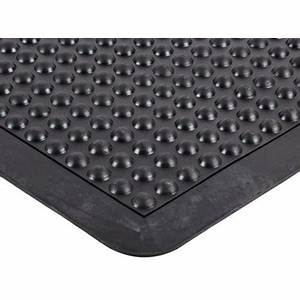
A warehouse floor has to serve two tribes who do not want the same thing: people on foot and people on wheels. Used carefully, industrial rubber mats can make standing work kinder and give grip in wet goods-in areas, but they become a hazard the moment they sit in an unmarked pallet-truck route or lift at the edge of a loading bay. The skill is to specify mats as workstation equipment, not as a scatter of black rectangles across the traffic plan.
This guide is for warehouse supervisors and facilities buyers. It is not a floor-loading calculation or a traffic-management design. No mat makes grease, ice or a broken dock plate safe by itself.
Separate standing work from rolling traffic
Walk the building at a peak inbound hour. Draw, even roughly, the pallet-truck desire lines, the pedestrian crossings, the bay thresholds and the places people stand still: scanners, stretch-wrap machines, relabelling tables, returns benches and the marshalling clipboards.
Mats belong on the standing patches. Vehicle routes should stay clear unless you have a product, fixing method and risk assessment that explicitly allow that traffic. A mat that can ruck under a pallet truck is worse than bare concrete.
If you need a longer, wipeable pedestrian band — for example along a packing mezzanine — compare rubber flooring rolls rather than lining up dozens of small mats like stepping stones.
Other ranges of industrial rubber mats are useful for comparing edge profiles. In a warehouse, the edge is a safety feature, not a cosmetic extra.
Loading bays and thresholds
Dock levellers, rain and condensation make bay thresholds messy. A washable mat on the pedestrian side of the door can give staff a better place to stand while checking paperwork or operating a panel. It should not overlap the leveller, foul a lorry's approach or hide a drain.
Keep clear:
- Dock locks and warning lights
- Pedestrian doors beside the shutter
- Yellow hatched exclusion zones
- Anything a driver must be able to see or stand on according to your site rules
If the bay floor ponds, fix the drainage. Covering standing water is not a control measure.
Where a long indoor pedestrian route needs a continuous surface, rubber flooring rolls can define that route visually as well as physically, which helps visiting drivers and agency staff.
Choosing a surface for warehouse dirt
Warehouse dirt is cardboard dust, stretch-wrap fragments, rain and the occasional leak from a pallet. Choose a texture you can sweep. A deep, fancy pattern that traps paper fines will be filthy by Thursday.
If oils or chemicals appear in a particular aisle, check compound suitability for that station rather than generalising across the building. Battery-charging areas, washing bays and packing benches may each need a different answer — or no mat at all.
Comfort still matters at scan-and-label points. A slightly resilient, stable mat is a reasonable provision for people who stand there all shift. It should stay put when someone turns with a parcel.
When you look at other industrial rubber mats or complementary rubber flooring rolls, ask how the product is meant to be cleaned with the equipment your contract cleaners already use.
Fixing, marking and inspection
Loose-lay is fine if the mat is heavy enough and sits wholly inside a standing zone. The first time a corner creeps into a truck route, either move it back and mark the zone, or change the product.
If you bond or mechanically fix anything, consider future layout changes and the floor finish. Keep fastener heads out of walking lines and never leave a lifted corner "until the weekend".
Marking helps. A painted or taped box around a packing station tells agency staff where the mat is supposed to live after they have moved it to sweep.
Inspect with your usual workplace tours:
- Edges flat and inside the zone?
- Texture still present in the standing patch?
- Contamination or damage underneath?
- Any evidence a truck has caught the mat?
Take damaged pieces out of service immediately. Store a spare for the busiest benches.
What not to do
Do not use mats to paper over a broken slab in a truck aisle. Do not place them on a slope where a pallet jack already struggles. Do not treat them as a substitute for suitable footwear, lighting or a traffic-management plan.
Do not specify electrical-insulation performance, food-grade status or chemical resistance unless the particular product is documented for that job.
Agency staff and visiting drivers will not know your unwritten rules. A short induction note — where mats live, where trucks must not go, and who to tell if a corner has lifted — prevents the tidy layout you specified on Monday being rearranged by Thursday. The same note should say that a mat is never a substitute for reporting a spill.
If you redesign a pick-face or add a packing mezzanine, review the mats at the same time as the racking plan. A station that has moved two metres will leave its old mat in a newly created aisle unless someone is responsible for relocating it.
Common mistakes
- Decorating an entire aisle "so it matches"
- Leaving a mat on the dock leveller "just for wet days"
- Choosing an aggressive scraper surface that no one can sweep
- Never lifting mats after a leaky inbound pallet
- Buying on thickness alone
Industrial rubber mats earn their place in warehouses at the standing jobs — scanning, wrapping, returns — and at carefully chosen pedestrian patches beside doors. Keep them out of unmarked rolling-traffic routes, inspect the edges, and treat drainage and traffic plans as part of the same decision.