

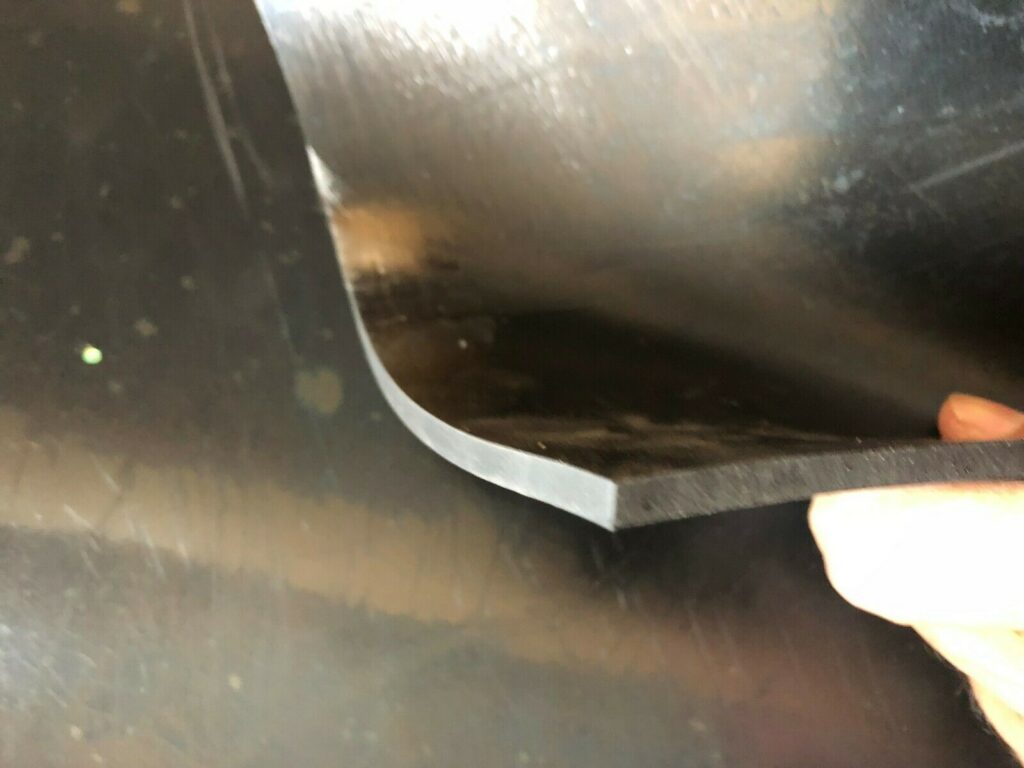
Plain rubber sheet is the unglamorous cousin of a moulded mat: a smooth or lightly finished material that you cut to the job. Trade buyers use it to line benches, protect van floors, make simple pads and cover awkward rectangles that no catalogue mat quite fits. It is not automatically the right choice wherever you would otherwise use industrial rubber mats, but it is often the faster, less wasteful answer when the space is an odd shape.
This guide is for workshops, van fitters and small contractors. Check the specification of the sheet you buy — compound, width and thickness all vary — and do not treat general-purpose sheet as electrical insulation, food-contact material or a certified safety surface unless the particular product is offered and documented for that use.
What sheet is good at
Sheet excels when you need a custom outline. Typical jobs include:
- Workbench tops and the strip behind a vice
- Cabinet and drawer liners in vans
- Pads under compressors, tool chests or small machines, where the manufacturer allows a firm pad
- Temporary protection during a fit-out
- Simple splash or kick protection on a low wall
- Covering a narrow sill or step that a standard mat would overhang
Because you cut it yourself, you can work around lashing points, pipework and pillar bases instead of buying a mat and then cutting most of it away.
What sheet does less well is offer a ready-made grip pattern, a finished edge, or the cushioning of a purpose-designed standing mat. If people will stand in one place all day, compare a moulded or anti-fatigue product rather than assuming a thin offcut is a workplace upgrade.
Ready-cut heavy duty garage floor mats still make more sense for a rectangular bay you do not want to fabricate.
Choosing a sheet without guessing
Read the product details rather than judging by colour. Points to confirm include:
- Compound and any notes about oil, ozone or indoor-only use
- Available widths and thicknesses — these commonly come in more than one option
- How the sheet is supplied (roll or cut length) and how it likes to be stored
- Whether it is intended as flooring, lining, or general fabrication
- Any temperature guidance if it will live in a van through a UK winter and a hot week in July
Sister-site ranges of rubber sheet for flooring and rubber sheet are useful for comparing how widths and cut lengths are sold. Use those listed specifications; do not assume every product titled "5mm" is only available in that thickness, and do not invent a single standard size for every job.
A firmer, thinner sheet is often better on a bench, where you want the work to stay put. A slightly thicker piece may be more comfortable as a kneeling strip, provided it still lies flat.
Cutting and fitting
Let a rolled sheet relax in the workshop before you mark it. Cold rubber from a van is stiff and will crawl after you cut it if you hurry.
Make a cardboard template for anything with cut-outs. Mark on the back if the face needs to stay cosmetic. Use a sharp blade, a straight edge and several passes on a sacrificial board. Keep hands behind the knife and clamp the work if you can.
On benches, many fitters use contact or other adhesives described as suitable for the pair of materials, or they simply let a heavy sheet sit and then bind the edges with a timber lip. On van floors, an unsecured leading edge will catch a crate and tear — plan fixings that do not leave sharp heads in a kneeling zone, and do not cover anything the vehicle converter told you to leave accessible.
Do not stretch sheet to make up a short measurement. Stretched rubber remembers, and it will shrink back from the corners.
If the same workshop also uses workshop floor mats in the standing bays, keep a visual distinction so offcuts of sheet do not migrate into walkways as half-finished, curling scraps.
When a moulded mat is the better buy
Choose a finished mat or tile instead of sheet when:
- You need a drainage or grip pattern that sheet does not have
- People will walk the surface all day and you want a defined edge system
- You need a product described for animal housing, play or specialist safety use
- The rectangle is a standard size and cutting would only add labour
- You want to be able to lift and wash a single piece without it rolling itself up
In those cases, look at workshop floor mats or other industrial formats rather than forcing sheet to imitate them.
Sheet leftovers should be stored flat or loosely rolled, away from sharp metal and hot pipes. A tangled offcut pile becomes waste.
Care and limitations
Sweep grit off sheet used as flooring; under a thin lining, grit becomes sandpaper against the surface beneath. Clean with a mild method unless the data sheet allows something stronger. Avoid assuming oil resistance: if the bench sees cutting fluids or diesel, check the compound.
Do not use unmarked general-purpose sheet as electrical matting, as a food surface, or as a guarantee against vibration damage to a machine. Those are specified jobs.
Common mistakes
- Cutting on the day the roll arrives, while it is still cold
- Leaving a raw leading edge in a van doorway
- Using sheet as a stand-in for independently assessed safety products
- Stretching a short piece to fit and watching it shrink next week
- Forgetting that a smooth sheet can be slick when wet with neat oil
Plain rubber sheet is a fabrication material for benches, vans and awkward spaces. Buy it by specification rather than by colour, cut it after it has relaxed, finish the edges so they cannot catch, and switch to a moulded industrial mat whenever the job is really about standing, draining or standardised floor cover.