

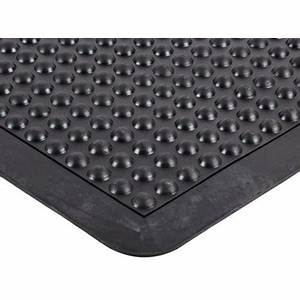
The least glamorous parts of a building often cause the most slips, stains and complaints: the bin store, the service yard behind the kitchen, the plant room door, the route to the grease trap. Well-specified outdoor rubber matting can make those routes easier to walk and easier to wash, provided you treat them as wet, dirty, working spaces rather than as a patio.
This guide is for facilities managers, landlords and contractors. A mat can improve grip compared with wet smooth concrete, but it will not make ice, grease or a broken slab safe on its own. Suitability depends on the product and on how the area is drained and maintained.
Map the dirt and the traffic
Walk the route on a wet evening collection day, not only at mid-morning after someone has rinsed it.
Note:
- Who uses it: staff with bags, residents, collection crews, contractors with trolleys
- What lands on the floor: rain, food waste, cardboard, oil, condensate, leaves
- Where water already ponds
- Any step, ramp or threshold that already has a worn nosing
- Whether vehicles or pallet trucks share the space
Mats belong where people walk and stand, and where a washable surface would help. They do not belong in a vehicle turning circle unless the product and fixing method are intended for that load.
If the standing problem inside a plant room is more about long spells at a panel than about outdoor muck, compare industrial rubber mats intended for indoor work areas and keep the outdoor product for the wet route in and out.
Drainage first
A service yard that ponds will turn any mat into a raft. Before you specify covering, look at falls, gulleys and blocked drains. Clearing a gulley can do more than ordering another square metre of rubber.
Choose a surface that can shed water: an open or textured pattern, or a layout that leaves the drain accessible. Do not bond a sheet over the only outlet "to neaten it".
At bin stores, think about wash-down. Staff will hose the area if you make that easy, and they will not if every mat has to be dragged out of a maze. Large pieces that can be stood on edge to dry are more realistic than a finely cut jigsaw.
Other ranges of outdoor rubber matting are useful when you need to compare how different products handle rain and grit, but the drainage question stays with the building.
Edges, thresholds and lighting
Edges cause incidents. A thick, dark lip on a poorly lit path between bins is easy to miss. Keep mats within the walking surface, use a visible or ramped edge where there is a change of level, and do not let a corner curl towards a fire exit.
On a ramp or step, extra thickness can create a new nosing hazard. A thinner, well-fixed covering may be more appropriate than a chunky tile. Follow product guidance and, for accessible routes, any duty you already have under building management.
Lighting belongs in the same conversation. A grippy mat in darkness still leaves people guessing where the edge is.
Where the same site needs tougher indoor standing patches — a warehouse door or goods-in desk — industrial rubber mats can be specified as a separate, complementary product rather than stretching an outdoor mat into a role it was not meant for.
Plant rooms and condensate
Plant rooms combine water, cables and occasional chemical dosing. Keep matting away from anything that must remain a clear, specified access to equipment. Do not cover gullies, floor leak-detection or labelled isolation points.
If condensate drips in one place, a mat can stop the surface immediately around it becoming a mossy film, but the lasting fix is to catch and drain the drip. Rubber is not a reason to ignore a leaking valve.
Choose compounds with an eye on whatever is actually spilled. If oils or treatment chemicals are present, check suitability rather than assuming every outdoor mat is indifferent to them.
A rubber floor mat outdoor at the plant-room threshold can stop the worst of the wet being walked onto stairs or carpeted corridors.
Maintenance that decides whether the purchase works
Write a simple regime into the cleaning contract:
- Sweep leaves and cardboard before they rot
- Hose or wash after messy collections
- Lift mats to clear silt from underneath
- Check edges after storms and after bin lorries have visited
- Take a damaged piece out of service
Grease from kitchen yards needs a cleaner that is compatible with both the mat and your drains. Residue left on the surface can be slicker than the concrete you started with.
In frost, treat matted routes as you would any external path. Texture can help; ice does not disappear because it is sitting on rubber.
Heavier heavy duty rubber mats may suit a defined standing spot beside a hopper or compactor if they can be kept clean and out of the lorry's path.
Common mistakes
- Covering a ponding yard and calling it a safety improvement
- Leaving unsecured edges on a night-time bin run
- Blocking the only drain
- Using indoor foam outdoors for a winter
- Forgetting the area in the cleaning specification
Outdoor rubber matting is a practical tool for service yards, bin stores and plant-room routes when the ground already drains, the edges are safe, and someone is paid to keep the surface clean. Specify it as part of how the back of house works, not as a sticker placed over a wet slab.