

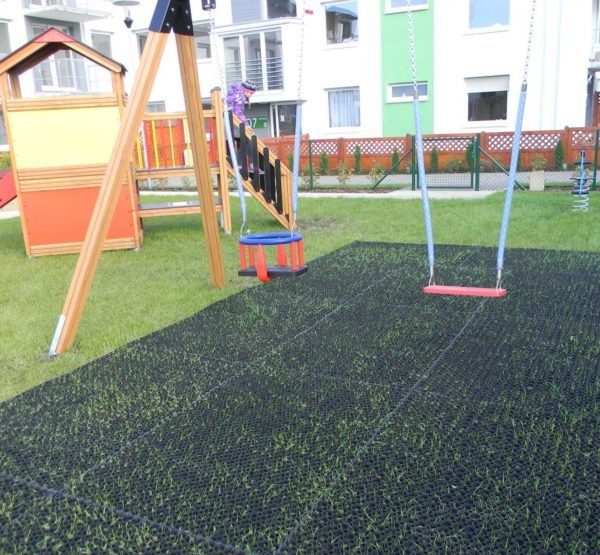
Buying a few black squares and placing them under a climbing frame is not the same as specifying a play surface. Nurseries, after-school clubs, parish playgrounds and contractors acting for them should treat playground safety mats as a specification and inspection exercise. The aim is a surface that suits the equipment, the fall heights involved and the way the site will be maintained — not a catalogue photograph that simply looks thick enough.
This guide sets out questions to ask. It does not certify any product, quote test results, or claim that a particular mat meets a named standard. Independent assessment, manufacturer documentation and, where required, competent inspection are what determine suitability. If those are not available for the combination of equipment and surfacing you propose, do not proceed as if they were.
Start with the equipment and the fall, not the mat
List every item of equipment and how children actually use it, including the unofficial uses staff already see: climbing on the outside of a frame, jumping from the second step, swinging in a way the designer did not emphasise.
For each item, establish the relevant fall information from the equipment supplier or a competent person. Surfacing that might be reasonable beside a low sit-on toy can be entirely inadequate under a taller climbing frame. Do not guess a safe height from the thickness of a mat.
Also record:
- Who owns the site and who inspects it
- Whether the area is public, locked, or used only under supervision
- Ground conditions: grass, mud, asphalt, concrete
- Drainage and winter access for maintenance
- Accessibility for buggies and wheelchair users if that is part of the site's duty
If the "problem" is only worn grass at a gateway or a watching spot, a grass protection mat or similar lawn protection may be the right product — and calling it playground safety surfacing would be misleading.
What a specification should ask the supplier
Ask for written answers, not verbal reassurance:
- What is the product intended for?
- What documentation exists for impact performance, and which test method does it refer to?
- Over what substrate was any test carried out? A result on one base does not automatically transfer to another.
- What fall height, if any, is associated with that documentation?
- How should tiles or mats be laid, edged and maintained for that performance to remain meaningful?
- What inspection regime does the supplier recommend?
- What is excluded: bikes, vehicles, adult events, frozen conditions and so on?
If the answers are vague, treat that as information. Comparing other ranges of playground safety mats is useful only when you compare documentation, not just price per square metre.
Do not add a general gym tile or stable mat to a play area and describe it as safety surfacing. Intended use matters.
Layout, edges and the wider site
Coverage should include the areas a competent layout would expect children to fall or jump into, not only the patch directly under a single seat. Follow guidance from the equipment supplier and any competent designer or inspector involved.
Edges are a frequent weakness. A thick, unsecured lip is a trip for children and adults. Transitions onto paths, grass and gates need as much thought as the centre of the pit.
Drainage matters all year. A flooded mat is heavy, can shift and may freeze. If the ground already ponds, solve that before you specify a surface that will hide the water.
Where the need is grass reinforcement beside a play space rather than impact attenuation, look at grass mats for play areas as a different product with a different job.
Access for maintenance: can staff lift or sweep the surface? Can a mower or strimmer damage an edge? Who will remove hidden broken glass after a weekend if the site is open?
Installation and records
Use installers who will follow the product instructions and leave you with a record of what was laid, on what base, on what date, and with which batch information. Photographs of the prepared ground are useful later.
Do not allow "we'll just put a few extra tiles down" to replace a layout drawing. The person who inspects the site next year will need to know what was intended.
If contractors are already on site with plant, do not confuse play surfacing with temporary ground protection mats used for vans and skips. Those products protect the ground from vehicles; they are not automatically play-safety surfaces.
Keep equipment installation instructions with the surfacing file. The two belong together.
Inspection after opening
A surface is not "done" on opening day. Build a routine:
- Visual checks for displacement, damage, trip edges and contamination
- Checks after bad weather and after fairs or unauthorised use
- A way to take a damaged piece out of service immediately
- Periodic review by a competent person where the site requires it
Children finding a loose tile will move it. Glass, bottle caps and animal mess will appear. Frozen surfaces need extra caution; no rubber mat makes ice safe.
Other playground safety mats on the market should be judged by the same inspection logic. If a product cannot be maintained with the staff time you actually have, it is the wrong product.
Common mistakes
- Choosing thickness by eye
- Treating a supplier website claim as a site-specific certificate
- Covering only the shadow of the equipment at noon
- Leaving raw edges on a desire-line path
- Filing no records of what was installed, then facing an incident later
Specify playground safety mats by starting with the equipment, the fall and the site, then asking for documentation and an installation method that still make sense after a wet British winter. Independent assessment and competent inspection matter more than the colour of the tile. If those pieces are not in place, pause the purchase.